
Data Matrix vs QR Code: Differences, Use Cases & Best Applications
Follow Us
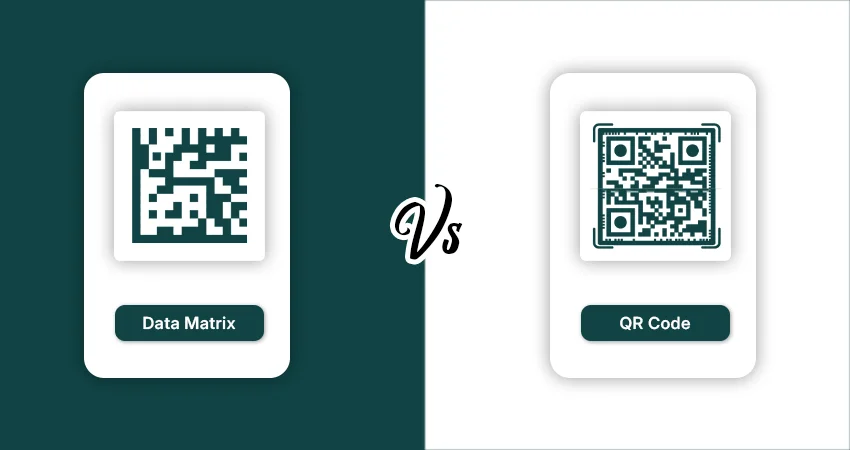
When companies start looking at modern barcode solutions, a common question is: “Data matrix vs. QR code – what’s the difference and what should be used?”
Both technologies are popular for storing and sharing information, but they serve different purposes. QR codes are popular for marketing, payments, and customer engagement, while data matrix codes are widely used in manufacturing, healthcare, and logistics.
Knowing the difference between these two code systems will help businesses make the right decision for inventory tracking, product labeling, marketing campaigns, or digital access.
In this guide, we’ll explore the differences between QR codes and data matrix codes, discuss where each one excels, and help you determine which one is best for your needs.
What Is a Data Matrix?
A data matrix is a two-dimensional barcode that consists of black and white cells arranged in a square or rectangular pattern. If you’ve ever wondered what it is, a data matrix code can store a lot of information in a minimal area.
In contrast to traditional barcodes, which store data horizontally, a matrix code stores data in both horizontal and vertical orientations. This means that it can hold more information even at a small size.
Common applications of data matrix codes are the following:
- Electronics parts
- Medical devices
- Product serial number(s)
- Manufacturing output
- Supply chain traceability
- Aerospace and automotive sectors
One of the main reasons industries prefer the data matrix format is that scanners can read it even when it’s partially damaged.
What are QR codes?
Before we can compare the data matrix to the QR code, we need to understand what QR codes are.
Another type of two-dimensional barcode is a QR code (Quick Response code), which is intended for rapid scanning and easy public use. QR codes are widely known because they can be immediately scanned by smartphones without any specialized equipment.
If you’re new to QR technology, you may also enjoy reading “What is a QR code?” to learn how these codes work in digital marketing, payments, and customer engagement.
Common uses for QR codes include:
- Website links
- Menus for restaurants
- E-payments
- Event tickets
- Sharing Wi-Fi
- Packing products
- Downloading apps
You can create both static and dynamic QR codes through a free QR code generator.
Data Matrix vs QR Code: Key Differences
Both are 2D barcodes, but they have some key differences.
Feature | QR Code | Data Matrix |
Appearance | Has three large squares in three corners for positioning | Has an L-shaped border on two sides for alignment |
Data Capacity | Can store larger amounts of data (URLs, text, multimedia links, etc.) | Designed for compact, dense data storage in a small space |
Scan Speed | Very fast and optimized for smartphone scanning and consumer use | Typically used with industrial scanners and controlled systems |
Size Efficiency | Requires more physical space for reliable scanning | Can be printed extremely small while remaining readable |
Error Correction | Strong error correction, highly reliable in public/mass use | Also supports error correction, but is generally optimized for industrial reliability in harsh conditions |
Industry Use | Marketing, payments, websites, business cards, social media sharing | Manufacturing, medical devices, electronics labeling, logistics, aerospace, and inventory systems |
Can QR and Datamatrix Be Used Together?
Some businesses look for terms such as “QR datamatrix” to determine whether the two technologies can coexist.
Yes, they can.
Many companies have QR codes on the customer-facing side, but inside, they’re using data matrix codes for inventory tracking and manufacturing.
For example:
Customers may receive a QR code on product packaging. The internal product component may include a data matrix code for factory tracking. Both systems can be used together to increase the operational efficiency and customer experience.
Final Words on QR Code and Data Matrix
The data matrix vs. QR code debate really comes down to what you want it to do and how you want to use it. QR codes are for accessibility, marketing, and consumer interaction. Data matrix codes are great for compact industrial and high-density labeling.
If you need very compact tracking solutions for manufacturing, healthcare, or logistics, data matrix codes are often the better choice. In fact, many businesses benefit from using both technologies in tandem, combining QR codes’ marketing power with the operational efficiency of data matrix systems.
As businesses become increasingly smart in their tracking and connectivity to digital systems, QR codes and data matrix codes will continue to be important tools for modern businesses.
Want to generate your own QR code?
Try QR Inventor’s free QR code generator to build dynamic, trackable, and modern QR experiences for your business or personal use today.
Frequently Asked Questions (FAQs)
In the data matrix vs. QR code comparison, QR codes are mainly used for marketing and public scanning, while data matrix codes are more suitable for industrial and manufacturing purposes.
Yes. Many smartphones are capable of scanning data matrix codes, but QR codes tend to be easier for mobile devices to recognize quickly.
Depends on the use case. QR codes are better for engaging customers, and data matrix is for labeling and tracking small products.
Depending on the QR service provider, dynamic QR codes can have an expiration date; however, a static QR code usually remains valid forever.
Categories


Table of Contents
- What Is a Data Matrix?
- What are QR codes?
- Data Matrix vs QR Code: Key Differences
- Can QR and Datamatrix Be Used Together?
- Final Words on QR Code and Data Matrix
- Frequently Asked Questions